The TRITON Project was proudly represented at the Artificial Intelligence 2026 Conference, where a scientific paper titled “AI-Enhanced Cybersecurity in Critical Infrastructures: A TRITON Framework and Review” was successfully presented.
This achievement marks an important milestone in TRITON’s dissemination activities, showcasing the project’s contribution to advancing AI-driven cyber defence solutions for security systems and critical infrastructures.
The presented paper explores how Artificial Intelligence (AI) is transforming penetration testing by enabling faster, more adaptive, and scalable approaches to security and resilience assessments.
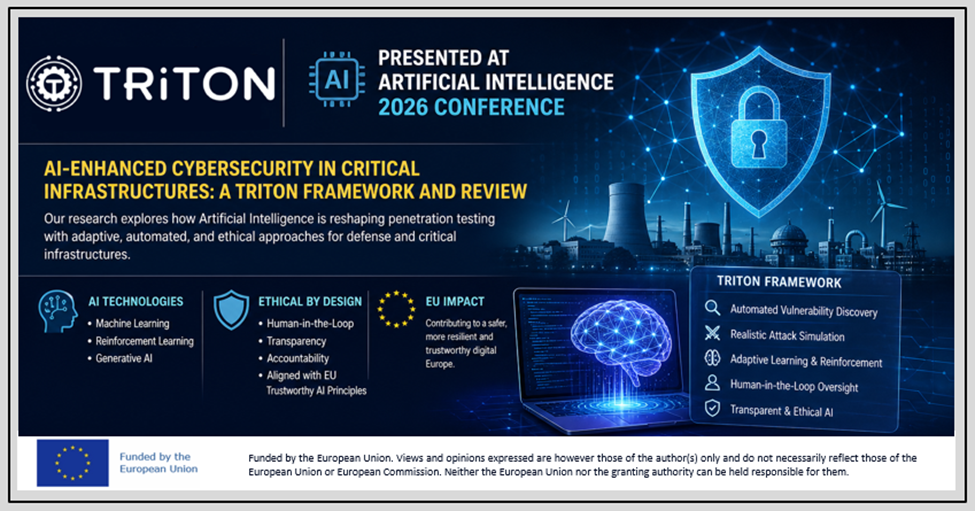
It introduces the TRITON framework, which integrates advanced AI technologies, including:
- Machine Learning (ML) for behavioural analysis and anomaly detection
- Reinforcement Learning (RL) for adaptive attack strategy development
- Generative AI for realistic cyberattack simulation
Through this approach, TRITON enhances the ability to identify vulnerabilities, simulate sophisticated cyber threats, and improve overall system resilience.
A key innovation highlighted in the paper is the human-in-the-loop paradigm, ensuring that AI-driven processes remain transparent, interpretable, and under human control, more specifically critical in high-risk environments such cyberspace operations and high-risk defence environments.
Beyond technological advancements, the paper emphasizes the importance of ethical AI deployment in cyber defence.
The TRITON framework addresses key challenges such as:
- Transparency and explainability of AI systems
- Accountability in automated decision-making
- Dual-use risks associated with AI technologies
By aligning with European principles for Trustworthy AI, TRITON ensures that innovation is balanced with responsibility, safety, and regulatory compliance.
The study also positions TRITON within the broader landscape of EU-funded initiatives, including:
- AI4CYBER
- CyberSecDome
While these initiatives focus on areas such as cyber situational awareness and real-time threat monitoring, TRITON distinguishes itself through its specialised focus on AI-driven automated penetration testing, particularly in regulated and mission-critical environments.
The publication is the result of a strong collaboration among leading academic and industrial partners across Europe:
- Technical University of Sofia – Leading the scientific contribution and coordination of the research work,
- UBITECH – Contributing expertise in AI-driven cybersecurity, DevSecOps, and real-world system integration,
- EXUS – Providing advanced data analytics and AI modelling capabilities,
- Universidad Politécnica de Madrid – Supporting the technical depth with expertise in AI and cybersecurity engineering,
- K3Y Ltd – Bringing applied cybersecurity experience in telecom and critical infrastructure environments, and
- University of Genoa – Contributing academic research excellence in cybersecurity and AI .
This multidisciplinary collaboration ensures that TRITON delivers innovative, practical, and ethically grounded cybers defence solutions. We deeply present our gratitude and honor to all contributing partners.
By combining cutting-edge technology with strong ethical governance, TRITON contributes to building secure, resilient, and trustworthy digital infrastructures across Europe.